McKie Supination Strap Accessory
(Thumb Splint Required for this item)
Supination is the forearm motion that turns the palm up. Whether child or adult, it is needed for most activities of daily living including eating, cup holding, dressing, bathing, combing hair, brushing teeth and holding a pencil. Control of supination develops very early when infants begin to explore all sides of objects. It can be lost or fail to develop as a result of neurological injury. The McKie Supination Strap assists the supinator muscle in the forearm.
- Made from 1.5 mm washable nylon-covered neoprene.
- Attaches to the back of the hand on the thumb side of the hand. The strap thus also assists with wrist extension and radial deviation.
- The narrowed end attaches to the McKie thumb splint or other hand splint and the squared end of the strap encircles the upper arm and attaches to itself.
- The hook tape at the squared end of the strap is not sewn on so the strap can be trimmed if too long.
- The smooth side nylon is worn against the skin and the outer looped nylon fabric is receptive to hook tape, thus allowing considerable adaptability when attaching the strapping.
- Latex free and available in 6 colors
- Custom options include adding length to the strap.
Supinator Strap Sizes
- X-Small (7/8 inch x 15 inches) straps are typically needed by infants.
- Small (1 inch x 18 inches) straps fit toddlers through about 6 years.
- Medium (1-1/2 inches x 24 inches) straps fit larger children, young teens and smaller adults.
- Large (2 inches x 30 inches) straps fits most adults and older teens.
Applying Splint
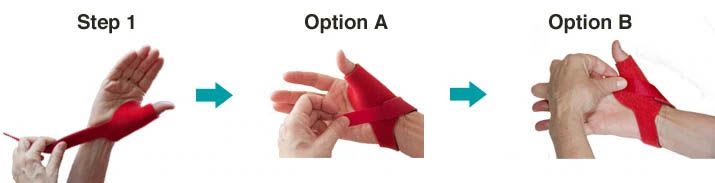
Step 1: Put the thumb through the thumb hole. Orient the splint so that the stitching follows the crest of the web between thumb and index finger. Snug to fit comfortably. Draw the strap of the splint at an angle so that it drops below the corner of the palm. (For medical personnel, it sits below the pisiform bone). Pull the split strap so it continues around the back of the hand all the way around again to the palm side.
Step 2: Depending on your intent, you can attach the hook tape in either of 2 ways:
Option A: If you are experiencing thumb pain or arthritis at the base of the thumb (C-M-C joint), direct the pull of the strap up into the base of the thumb metacarpal as illustrated.
Option B: If you are attempting to improve grasp quality, attach the hook tape to put mild pressure on the head of the thumb metacarpal.
Applying Supinator Strap

Step 1: To attach supinator strap, undo strap from thumb splint. Reattach thumb splint over supinator strap. (figure 3)
Step 2: Wind one turn around forearm, then one turn behind elbow. Attach wider, squared hook tape end of strap to itself above elbow (figure 4). The splint is designed to assist forearm extension, so supinator strap must cut across the back of elbow.
Step 3: Once splint is in place, passively turn forearm palm up (supination) and slightly extend wrist (figure 5). Make any necessary adjustments to supinator strap to ensure a snug fit. The attachment above the elbow, while snug, should be comfortable, balancing good coloration of the hand with some pull from the strap.
Step 4: Finally, check the hand splint and, if necessary, rotate it to ensure the thumb is positioned to oppose fingers.
Always follow precautions on label regarding splint application and wear.
Fitting Thumb Splint and Adjustable Supinator Strap
Both the strap of the Thumb Splint and the Adjustable Supinator Strap may be shortened to accommodate different size hands or to compensate for some loss of elasticity in the straps that occurs over time.
How to Size Thumb Splint
Use A and B measurements to determine which size splint you should order.
1. Measurement A
Measure to the 1/10th of a centimetre the circumference of the far or distal thumb joint.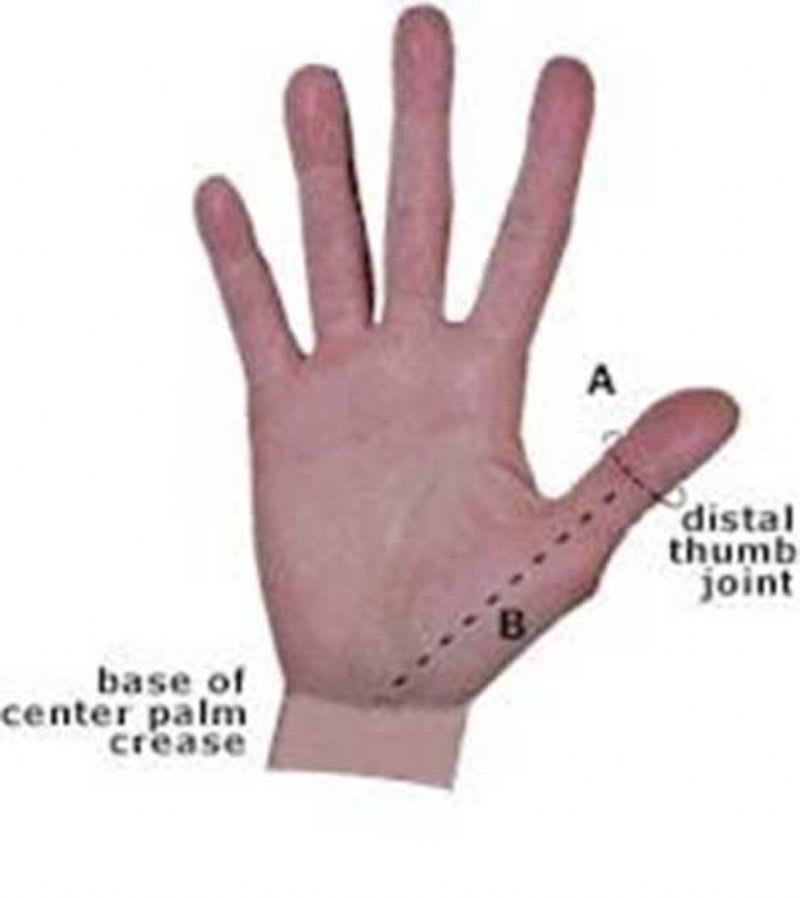
2. Measurement B
Measure to the 1/10th of a centimetre the distance on the palm from the distal thumb joint to the centre of the wrist crease.
3. Measurement F (only used for custom splints)
Measure from the distal thumb crease to the bottom of the web space.
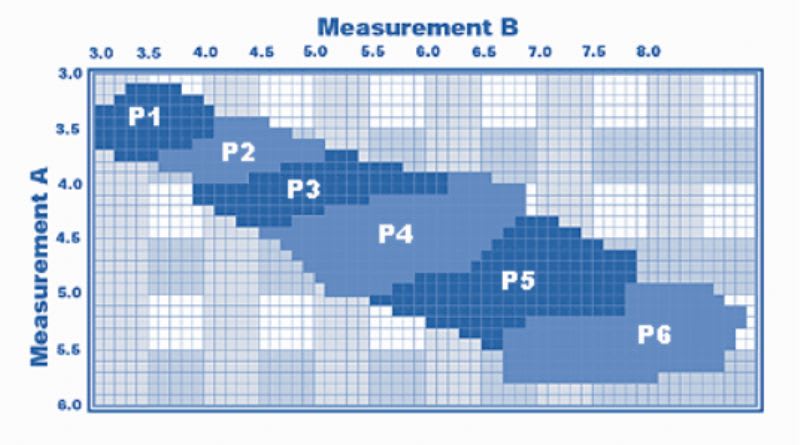
4. Refer to Chart
On the appropriate chart (see below), find the the square where Measurement A and Measurement B meet. The square should fall within a bold area corresponding to the correct size. If Neonatal use only Measurement A an Neonatal Sizing and refer to the neonatal chart for neonatal sizing.
Example:
If Measurement A = 5.2 centimetre’s and Measurement B = 6.0 centimetre’s, then splint size = P5
How It Works
Neurological/ Developmental Deficits
-
The thumb is drawn into opposition. The splint pulls in the same direction as muscle attached to the thumb.
-
Because active, opposed grasp is supported, the potential for acquisition of abnormal, compensatory grasp patterns is diminished.
-
The neoprene is only 1.5mm and coverage of the palm is minimal, thus adequate space is left in the hand to manipulate and explore objects.
-
Normal hand use and development is thus not thwarted by the splint itself.
-
For weakness and hypermobility at the M-P joint, strap placement at the head of the metacarpal will block hyperextension.
Arthritis / Injury
-
The splint provides light compression.
-
It cushions the thenar eminence and reduces joint play.
-
At the C-M-C joint, the splint strap can be attached to provide lift to the thumb metacarpal and increase joint space.
-
For weakness and hypermobility at the M-P joint, strap placement at the head of the metacarpal will block hyperextension.
Supinator Strap Features
Supination is the forearm motion that turns the palm up. Whether child or adult, it is needed for most activities of daily living including eating, cup holding, dressing, bathing, combing hair, brushing teeth and holding a pencil. Control of supination develops very early when infants begin to explore all sides of objects. It can be lost or fail to develop as a result of neurological injury.
How It Works: Supinator Strap
-
Attaches to the back of the splint to aid radial deviation and wrist extension.
-
It wraps around the forearm to pull the hand into supination.
-
When self-attached above the elbow, facilitates elbow extension.
-
The strap can also be attached to promote forearm pronation
Who Can Benefit from Supination?
-
Adults with Stroke or Neurological Injury
-
Children with Cerebral Palsy who have impaired reach and weight bearing of the upper limb
-
Children with Brachial Plexus Injury
-
Children with Arthrogryposis