McKie Thumb Splint (Adult Sizes)
- Thumb abduction and opposition splint
- Sized to fit teens and adults
- The McKie Thumb Splint offers support for the following injuries and disabilities:
Neurological conditions - Cerebral Palsy, De Quervain's, Hemiplegia
Physical conditions - Arthritis, Tendonitis, Trigger Thumb, Thumb Injury
-
The Mckie adult thumb splint features streamlined design dynamically assists grasp.
-
Minimal palmar coverage allows the hand to function more normally -- to feel and manipulate objects.
-
The thumb splint can be fastened either to support the joint at the base of the thumb (CMC arthritis and pain at the base of the thumb) or the it can be fastened to address neurological issues such as weakness or spasticity.
-
Made from 1.5 mm thick, washable, nylon-covered neoprene.
-
The smooth side nylon thumb is worn against the skin. The outer fabric is a closed loop Nylon fabric which allows attachment of the hook tape anywhere on the splint, thus making it adaptable to a variety of applications.
-
Latex free.
-
Extra hook tape is available for purchase. Velcro® brand as well as other hook tape brands are used in the manufacture of the McKie® Thumb Splint.
-
McKie Thumb Splint Features
-
All McKie Thumb Splints and Supinator Straps are made of washable, 1.5 mm fabric-covered neoprene. Outer fabric is looped Nylon which allows attachment of hook tape anywhere on the splints.
How It Works
Neurological / Developmental Deficits
-
The thumb is drawn into opposition. The splint pulls in the same direction as muscle attached to the thumb.
-
Because active, opposed grasp is supported, the potential for acquisition of abnormal, compensatory grasp patterns is diminished.
-
Arthritis / Injury
-
The splint provides light compression.
-
It cushions the thenar eminence and reduces joint play.
-
At the C-M-C joint, the splint strap can be attached to provide lift to the thumb metacarpal and increase joint space.
-
For weakness and hypermobility at the M-P joint, strap placement at the head of the metacarpal will block hyperextension.
-
The neoprene is only 1.5mm and coverage of the palm is minimal, thus adequate space is left in the hand to manipulate and explore objects.
-
Normal hand use and development is thus not thwarted by the splint itself.
-
For weakness and hypermobility at the M-P joint, strap placement at the head of the metacarpal will block hyperextension.
Sizing for Adults and Children
To assure the best fit, use of a sizing kit is strongly recommended. If a sizing kit is unavailable, follow the directions below. Neonatal sizes are suitable for very small or prematurely born infants. Pediatric sizes are suitable for children from about 3 months to 6-10 years. Older children and adults need adult sizes. When figuring sizes, it is important to use a centimeter tape measure.
How to Determine Thumb Splint Size
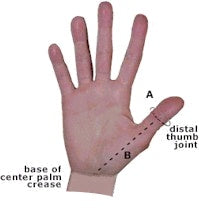
1. Measurement A
Measure to the 1/10th of a centimeter the circumference of the far or distal thumb joint.
2. Measurement B
Measure to the 1/10th of a centimeter the distance on the palm from the distal thumb joint to the center of the wrist crease.
3. Refer to Chart
On the appropriate chart , find the the square where Measurement A and Measurement B meet. The square should fall within a bold area corresponding to the correct size.

Fitting Thumb Splint with an Adjustable Supinator Strap
Both the strap of the Thumb Splint and the Adjustable Supinator Strap may be shortened to accommodate different size hands or to compensate for some loss of elasticity in the straps that occurs over time.
Thumb Splint

If after trying the on the splint, the splint strap and velcro protrude beyond the thumb, cut strap and/or hook tape to fit the hand.
Supinator Strap
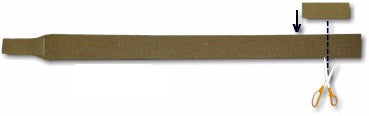
The squared end of the supinator strap may be cut to fit a shorter or narrower forearm. Attach free piece of hook tape to the squared end of strap.